Thursday, April 9, 2009

thalailama

Dalai Lama


http://www.seithy.com/admin/upload/thalai%20lama_150.jpg


Name: Tenzin Gyatso
His Holiness Dalai Lama (HHDL)

DOB : 6th July, 1935
Category: Leaders
Country: Tibet

The 14th Dalai Lama (Tibetan Buddhist Monk) was born on July, 6th 1935 as a fifth child to his parents. His parents Choekyong and Dekyi Tsering were farmers. He was named Tenzin Gyatso.

The thirteenth Dalai Lama turned to face the Northeast while he was dying, indicating the area where the next Dalai Lama should be found. The senior lama saw the house of the next Dalai Lama in his vision and a search for the house was arranged. They found the boy and Tenzin Gyatso turned in to 14th Dalai Lama at the age of three.

He is also called as Yeshe Norbu or Kundun. In western countries he is popularly known as "His Holiness Dalai Lama". Dalai Lama was named the leader of Tibet in the 50's. The army of People's Republic of China entered in to Tibetan territory on October 1950. He negotiated with China till 1959. He fled to India on March 17, 1959.

Dalai Lama heads the International Tibet Independence Movement. Dalai Lama works from the "government of Tibet in Exile" in "Dharamsala, India". Tibetan parliament-in-exile is elected by the refugees in India. This Buddhist Leader was awarded the Nobel Peace Prize on 1989 for his struggle towards the liberation of Tibet by peaceful resolution instead of using violence.

He calls himself as a "simple Buddhist monk".


more deatils; wikipediya

martin luther king

Martin Luther King Jr.

The Nobel Peace Prize 1964


http://static.pyzam.com/img/graphics/3/ab_mlk3.gif

Martin Luther King, Jr., (January 15, 1929-April 4, 1968) was born Michael Luther King, Jr., but later had his name changed to Martin. His grandfather began the family's long tenure as pastors of the Ebenezer Baptist Church in Atlanta, serving from 1914 to 1931; his father has served from then until the present, and from 1960 until his death Martin Luther acted as co-pastor. Martin Luther attended segregated public schools in Georgia, graduating from high school at the age of fifteen; he received the B. A. degree in 1948 from Morehouse College, a distinguished Negro institution of Atlanta from which both his father and grandfather had graduated. After three years of theological study at Crozer Theological Seminary in Pennsylvania where he was elected president of a predominantly white senior class, he was awarded the B.D. in 1951. With a fellowship won at Crozer, he enrolled in graduate studies at Boston University, completing his residence for the doctorate in 1953 and receiving the degree in 1955. In Boston he met and married Coretta Scott, a young woman of uncommon intellectual and artistic attainments. Two sons and two daughters were born into the family.

In 1954, Martin Luther King became pastor of the Dexter Avenue Baptist Church in Montgomery, Alabama. Always a strong worker for civil rights for members of his race, King was, by this time, a member of the executive committee of the National Association for the Advancement of Colored People, the leading organization of its kind in the nation. He was ready, then, early in December, 1955, to accept the leadership of the first great Negro nonviolent demonstration of contemporary times in the United States, the bus boycott described by Gunnar Jahn in his presentation speech in honor of the laureate. The boycott lasted 382 days. On December 21, 1956, after the Supreme Court of the United States had declared unconstitutional the laws requiring segregation on buses, Negroes and whites rode the buses as equals. During these days of boycott, King was arrested, his home was bombed, he was subjected to personal abuse, but at the same time he emerged as a Negro leader of the first rank.

In 1957 he was elected president of the Southern Christian Leadership Conference, an organization formed to provide new leadership for the now burgeoning civil rights movement. The ideals for this organization he took from Christianity; its operational techniques from Gandhi. In the eleven-year period between 1957 and 1968, King traveled over six million miles and spoke over twenty-five hundred times, appearing wherever there was injustice, protest, and action; and meanwhile he wrote five books as well as numerous articles. In these years, he led a massive protest in Birmingham, Alabama, that caught the attention of the entire world, providing what he called a coalition of conscience. and inspiring his "Letter from a Birmingham Jail", a manifesto of the Negro revolution; he planned the drives in Alabama for the registration of Negroes as voters; he directed the peaceful march on Washington, D.C., of 250,000 people to whom he delivered his address, "l Have a Dream", he conferred with President John F. Kennedy and campaigned for President Lyndon B. Johnson; he was arrested upwards of twenty times and assaulted at least four times; he was awarded five honorary degrees; was named Man of the Year by Time magazine in 1963; and became not only the symbolic leader of American blacks but also a world figure.

At the age of thirty-five, Martin Luther King, Jr., was the youngest man to have received the Nobel Peace Prize. When notified of his selection, he announced that he would turn over the prize money of $54,123 to the furtherance of the civil rights movement.

On the evening of April 4, 1968, while standing on the balcony of his motel room in Memphis, Tennessee, where he was to lead a protest march in sympathy with striking garbage workers of that city, he was assassinated.

more deatils; wikipediya

Wednesday, April 8, 2009

christopher columbus

Christopher Columbus

http://www.nndb.com/people/033/000045895/chrisColumbus.jpg

Born: 1451
Birthplace: Genoa, Italy
Died: 20-May-1506
Location of death: Valladolid, Spain
Cause of death: unspecified
Remains: Buried, Seville Cathedral, Spain

Gender: Male
Religion: Roman Catholic
Race or Ethnicity: White
Sexual orientation: Straight
Occupation: Explorer

Nationality: Italy
Executive summary: Rediscovered the New World

Columbus was the eldest son of Domenico Colombo and Suzanna Fontanarossa, and was born at Genoa either about 1446 or in 1451, the exact date being uncertain. His father was a wool-comber, of some small means, who lived until 1498. According to the life of Columbus by his son Ferdinand (a statement supported by Las Casas), young Christopher was sent to the university of Pavia, where he devoted himself to astronomy, geometry and cosmography. Yet, according to the admiral's own statement, he became a sailor at fourteen. Evidently this statement, however, cannot mean the abandonment of all other employment, for in 1470, 1472, and 1473 we find him engaged in trade at Genoa, following the family business of weaving, and (in 1473) residing at the neighboring Savona. In 1474-75 he appears to have visited Chios, where he may have resided some time, returning to Genoa perhaps early in 1476. From there he seems to have again set out on a voyage in the summer of 1476, perhaps bound for England; on the 13th of August 1476, the four Genoese vessels he accompanied were attacked off Cape St. Vincent by a privateer, one Guillaume de Casenove, surnamed Coullon or Colombo ("Columbus"); two of the four ships escaped, with Christopher, to Lisbon. In December 1476, the latter resumed their voyage to England, probably carrying with them Columbus, who, after a short stay in England, claims to have made a voyage in the northern seas, and even to have visited Iceland about February 1477. This last pretension is gravely disputed, but it is perhaps not to be rejected, and we may also trace the Genoese about this time at Bristol, at Galway, and probably among the islands west and north of Scotland. Soon after this he returned to Portugal, where (probably in 1478) he married a lady of some rank, Felipa Moñiz de Perestrello, daughter of Bartholomew Perestrello, a captain in the service of Henry the Navigator, and one of the early colonists and first governor of Porto Santo. Felipa was also a cousin of the archbishop of Lisbon at this time (1478).

About 1479 Columbus visited Porto Santo, here as in Portugal probably employing his time in making maps and charts for a livelihood, while he pored over the logs and papers of his deceased father-in-law, and talked with old seamen of their voyages, and of the mystery of the western seas. About this time, if not earlier, he seems to have arrived at the conclusion that much of the world remained undiscovered, and step by step conceived that design of reaching Asia by sailing west which was to result in the discovery of America. In 1474 he is said to have corresponded with Paolo Toscanelli, the Florentine physician and cosmographer, and to have received from him valuable suggestions, both by map and letter, for such a Western enterprise. (The whole of this incident has been disputed by some critics.) He had perhaps already begun his studies in a number of works, especially the Book of Marco Polo and the Imago Mundi of Pierre d'Ailly, by which his cosmographical and geographical conceptions were largely moulded. His views, as finally developed and presented to the courts of Portugal and Spain, were supported by three principal lines of argument, derived from natural reasons, from the theories of geographers, and from the reports and traditions of mariners. He believed the world to be a sphere; he underestimated its size; he overestimated the size of the Asiatic continent. And the farther that continent extended towards the east, the nearer it came towards Spain. Nor were these theories the only supports of his idea. Martin Vicente, a Portuguese pilot, was said to have found, 400 leagues to the westward of Cape St. Vincent, and after a westerly gale of many days' duration, a piece of strange wood, wrought, but not with iron; Pedro Correa, Columbus's own brother-in-law, was said to have seen another such waif at Porto Santo, with great canes capable of holding four quarts of wine between joint and joint, and to have heard of two men being washed up at Flores "very broadfaced, and differing in aspect from Christians." West of Europe, now and then, men fancied there hove in sight the mysterious islands of St. Brandan, of Brazil, of Antillia or of the Seven Cities. In his northern journey, too, some vague and formless traditions may have reached the explorer's ear of the voyages of Leif Ericsson and Thorfinn Karlsefne, and of the coasts of Markland and Vinland. All were hints and rumors to bid the bold mariner sail towards the setting sun, and this he at length determined to do.

The concurrence of some state or sovereign, however, was necessary for the success of this design. Columbus, on the accession of João II of Portugal, seems to have entered the service of this country, to have accompanied Diego d'Azambuja to the Gold Coast, and to have taken part in the construction of the famous fort of St. George at El Mina (1481-82). On his return from this expedition, he submitted to João the scheme he had now matured for reaching Asia by a western route across the ocean. The king was deeply interested in the rival scheme (of an eastern or southeastern route around Africa to India) which had so long held the field, which had been initiated by the Genoese in 1291, and which had been revived, for Portugal, by Henry the Navigator; but he listened to the Genoese, and referred him to a committee of council for geographical affairs. The council's report was adverse; but the king, who was yet inclined to favor the theory of Columbus, assented to the suggestion of the bishop of Ceuta that the plan should be carried out in secret and without its author's knowledge. A caravel was despatched; but it returned after a brief absence, the sailors having lost heart, and refused to venture farther. Upon discovering this treachery, Columbus left Lisbon for Spain (1484), taking with him his son Diego, the only issue of his marriage with Felipa Moñiz, who was by this time dead. He departed secretly -- according to some writers, to give the slip to João; according to others, to escape his creditors.

Columbus next betook himself to the south of Spain, and while meditating an appeal to the king of France, opened his plans to the count (from 1491, duke) of Medina Celi. The latter gave him great encouragement, entertained him for two years, and even determined to furnish him with three or four caravels, to carry out his great design. Finally, however, being deterred by the consideration that the enterprise was too vast for a subject, he turned his guest from the determination he had come to of making application at the court of France, by writing on his behalf to Queen Isabella; and Columbus repaired to the court at Cordova at her bidding (1486).

It was a poorly-timed moment for the navigator's fortune. Castile and Leon were in the thick of that struggle which resulted in the final conquest of the Granada Moors; and neither Ferdinand nor Isabella had time as yet to give due consideration to Columbus' proposals. The adventurer was indeed kindly received; he was handed over to the care of Alonso de Quintanilla, whom he speedily converted into an enthusiastic supporter of his theory. He made many other friends, and among them Beatriz Enriquez, the mother of his second son Fernando. But the committee, presided over by the queen's confessor, Fray Hernando de Talavera, which had been appointed to consider the new project, reported that it was vain and impracticable.

From Cordova Columbus followed the court to Salamanca, having already been introduced by Quintanilla to the notice of the grand cardinal, Pedro Gonzalez de Mendoza, "the third king of Spain"; the latter had befriended and supported the Genoese, and apparently arranged the first interview between him and Queen Isabella. At Salamanca prolonged discussions took place upon the questions now raised; the Dominicans of San Esteban entertained Columbus during the conferences (1486-87). In 1487 Columbus, who had been following the court from place to place (billeted in towns as an officer of the sovereigns, and gratified from time to time with sums of money towards his expenses), was present at the siege of Malaga. In 1488 he was invited by the king of Portugal, his "especial friend", to return to that country, and was assured of protection against arrest or proceedings of any kind (March 20): he had probably made fresh overtures to King João shortly before; and in the autumn of 1488 we find him in Lisbon, conferring with his brother Bartholomew and laying plans for the future. We have no record of the final negotiations of Columbus with the Portuguese government, but they clearly did not issue in anything definite, for Christopher now returned to Spain (though not until he had witnessed the return of Bartholomew Diaz from the discovery of the Cape of Good Hope and his reception by King João.), while Bartholomew proceeded to England with a mission to interest King Henry VII in the Columbian schemes. If the London enterprise was unsuccessful (as indeed it proved), it was settled that Bartholomew should carry the same invitation to the French court. He did so; and here he remained until summoned to Spain in 1493. Meantime Christopher, unable throughout 1490 to get a hearing at the Spanish court, was in 1491 again referred to a junta, presided over by Cardinal Mendoza; but this junta, to Columbus' dismay, once more rejected his proposals; the Spanish sovereigns merely promised him that when the Granada war was over, they would reconsider what he had laid before them.

Columbus was now in despair. He at once betook himself to Huelva, a little maritime town in Andalusia, northwest of Cadiz, with the intention of taking ship for France. He halted, however, at the monastery of La Rabida, near Huelva, and still nearer Palos, where he seems to have made lasting friendships on his first arrival in Spain in January 1485, where he especially enlisted the support of Juan Perez, the guardian, who invited him to take up his quarters in the monastery, and introduced him to Garcia Fernandez, a physician and student of geography. Juan Perez had been the queen's confessor; he now wrote to her in urgent terms, and was summoned to her presence; and money was sent to Columbus to bring him once more to court. He reached Granada in time to witness the surrender of the city (January 2, 1492), and negotiations were resumed. Columbus believed in his mission, and stood out for high terms; he asked for the rank of admiral at once ("Admiral of the Ocean" in all those islands, seas, and continents that he might discover), the vice-royalty of all he should discover, and a tenth of the precious metals discovered within his admiralty. These conditions were rejected, and the negotiations were again interrupted. An interview with Mendoza appears to have followed; but nothing came of it, and before the close of January 1492, Columbus actually set out for France. At length, however, on the entreaty of the Queen's confidante, the Marquesa de Moya, of Luis de Santangel, receiver of the ecclesiastical revenues of the crown of Aragon, and of other courtiers, Isabella was induced to determine on the expedition. A messenger was sent after Columbus, and overtook him near a bridge called "Pinos", 6 miles from Granada. He returned to the camp at Santa Fe, and on the 17th of April 1492, the agreement between him and their Catholic majesties was signed and sealed.

As his aims included not only the discovery of Cipangu or Japan, but also the opening up of intercourse with the grand khan of Cathay, he received a royal letter of introduction to the latter. The town of Palos was ordered to find him two ships, and these were soon placed at his disposal. But no crews could be got together, in spite of the indemnity offered to criminals and "broken men" who would serve on the expedition; and had not Juan Perez succeeded in interesting in the cause the Palos "magnates" Martin Alonso Pinzon and Vicente Yañez Pinzon, Columbus' departure had been long delayed. At last, however, men, ships and stores were ready. The expedition consisted of the "Santa Maria", a decked ship of 100 tons with a crew of 52 men, commanded by the admiral in person; and of two caravels; the "Pinta" of 50 tons, with 18 men, under Martin Pinzon; and the "Niña", of 40 tons, with 18 men, under his brother Vicente Yañez, afterwards (1499) the first to cross the line in the American Atlantic.

The adventurers numbered 88 souls; and on Friday, the 3rd of August 1492, at eight in the morning, the little fleet weighed anchor, and stood for the Canary Islands. An abstract of the admiral's diary made by Las Casas is yet extant; and from it many particulars may be gleaned concerning this first voyage. Three days after the ships had set sail the "Pinta" lost her rudder; the admiral was in some alarm, but comforted himself with the reflection that Martin Pinzon was energetic and ready-witted; they had, however, to put in at Teneriffe, to refit the caravel. On the 6th of September they weighed anchor once more with all haste, Columbus having been informed that three Portuguese caravels were on the lookout to intercept him. On the 13th of September the westerly variations of the magnetic needle were for the first time observed; on the 15th a meteor fell into the sea at four or five leagues distance; soon after they arrived at those vast plains of seaweed called the Sargasso Sea; while all the time, writes the admiral, they had most temperate breezes, the sweetness of the mornings being especiaily delightful, the weather like an Andalusian April, and only the song of the nightingale wanting. On the 17th the men began to murmur; they were frightened by the strange phenomena of the variation of the compass, but the explanation Columbus gave restored their tranquillity. On the 18th they saw many birds, and a great ridge of low-lying cloud; and they expected to see land. On the 20th they saw boobies and other birds, and were sure the land must be near. In this, however, they were disappointed; and thenceforth Columbus, who was keeping all the while a double reckoning, one for the crew and one for himself, had great difficulty in restraining the evil-disposed from the excesses they meditated. On the 25th Martin Alonso Pinzon raised the cry of land, but it proved false, as did the rumor to the same effect on the 7th of October, from the "Niña." But on the 11th the "Pinta" fished up a cane, a pole, a stick which appeared to have been wrought with iron, and a board, while the "Niña" sighted a branch covered with berries; "and with these signs all of them breathed and were glad." At ten o'clock on that night Columbus himself perceived and pointed out a light ahead, and at two in the morning of Friday, the 12th of October 1492, Rodrigo de Triana, a sailor aboard the "Niña", announced the appearance of what proved to be the New World. The land sighted was an island, called by the Indians "Guanahani", and named by Columbus San Salvador. It is generally identified with Watling Island.

The same morning Columbus landed, richly clad, and bearing the royal banner of Spain. He was accompanied by the brothers Pinzon, bearing banners of the Green Cross (a device of the admirals), and by great part of the crew. When they all had "given thanks to God, kneeling upon the shore, and kissed the ground with tears of joy, for the great mercy received", the admiral named the island, and took solemn possession of it for their Catholic majesties of Castile and Leon. At the same time such of the crews as had shown themselves doubtful and mutinous sought his pardon weeping, and prostrated themselves at his feet.

Into the remaining detail of this voyage, of highest interest as it is, it is impossible to go further. It will be enough to say that it resulted in the discovery of the islands of Santa Maria de la Concepcion (Rum Cay), Fernandina (Long Island), Isabella (Crooked Island), Cuba or Juana (named by Columbus in honor of the young prince of Spain), and Hispaniola, Haiti, or San Domingo. Off the last of these the "Santa Maria" went aground, owing to the carelessness of the steersman. No lives were lost, but the ship had to be unloaded and abandoned; and Columbus, who was anxious to return to Europe with the news of his achievement, resolved to plant a colony on the island, to build a fort out of the material of the stranded hulk, and to leave the crew. The fort was called La Navidad; 44 Europeans were placed in charge. On the 4th of January 1493 Columbus, who had lost sight of Martin Pinzon, set sail alone in the "Niña" for the east; and two days afterwards the "Pinta" joined her sister ship. A storm, however, separated the vessels, and it was not until the 18th of February that Columbus reached the island of Santa Maria in the Azores. Here he was threatened with capture by the Portuguese governor, who could not for some time be brought to recognize his commission. On the 24th of February, however, he was allowed to proceed, and on the 4th of March the "Niña" dropped anchor off Lisbon. The king of Portugal received the admiral with the highest honors. On the 13th of March the "Niña" put out from the Tagus, and two days afterwards, Friday, the 15th of March, she reached Palos.

The court was at Barcelona; and to there, after despatching a letter announcing his arrival, Columbus proceeded in person. He entered the city in a sort of triumphal procession, was received by their majesties in full court, and, seated in their presence, related the story of his wanderings, exhibiting the "rich and strange" spoils of the new-found lands -- the gold, the cotton, the parrots, the curious arms, the mysterious plants, the unknown birds and beasts, and the Indians he had brought with him for baptism. All his honors and privileges were confirmed to him; the title of Don was conferred on himself and his brothers; he rode at the king's bridle; he was served and saluted as a grandee of Spain. A new and magnificent scutcheon was also blazoned for him (4th May 1493), whereon the royal castle and lion of Castile and Leon were combined with the five anchors of his own coat of arms. Nor were their Catholic highnesses less busy on their own account than on that of their servant. On the 3rd and 4th of May Pope Alexander VI granted bulls confirming to the crowns of Castile and Leon all the lands discovered, or to be discovered, west of a line of demarcation drawn 100 leagues west of the Azores, on the same terms as those on which the Portuguese held their colonies along the African coast. A new expedition was got in readiness with all possible despatch, to secure and extend the discoveries already made.

After several delays the fleet weighed anchor on the 24th of September 1493 and steered westwards. It consisted of three great carracks (galleons) and fourteen caravels (light frigates), having on board over 1500 men, besides the animals and materials necessary for colonization. Twelve missionaries accompanied the expedition, under the orders of Bernardo Buil or Boil, a Benedictine; Columbus had been already directed (29th May 1493) to endeavor by all means in his power to Christianize the inhabitants of the islands, to make them presents, and to "honor them much", while all under him were commanded to treat them "well and lovingly", under pain of severe punishment. On the 13th of October the ships, which had put in at the Canaries, left Ferro; and on Sunday, the 3rd of November, after a single storm, "by the goodness of God and the wise management of the admiral" an island was sighted to the west, which was named Dominica. Northwards from this the isles of Marigalante and Guadalupe were next discovered and named; while on the northwestern course to La Navidad those of Montserrat, Antigua, San Martin, Santa Cruz and the Virgin Islands were sighted, and the island now called Puerto Rico was touched at, hurriedly explored, and named San Juan Bautista. On the 22nd of November Columbus came in sight of Hispaniola, and sailing westward to La Navidad, found the fort burned and the colony dispersed. He decided on building a second fort, and coasting on 30 miles east of Monte Cristi, he pitched on a spot where he founded the city of Isabella.

The climate proved unhealthy; the colonists were greedy of gold, impatient of control, proud, ignorant and mutinous; and Columbus, whose inclination drew him westward, was doubtless glad to escape the worry and anxiety of his post, and to avail himself of the instructions of his sovereigns as to further discoveries. On the 2nd of February 1494 he sent home, by Antonio de Torres, that despatch to their Catholic highnesses by which he may be said to have founded the West Indian slave trade. He established the mining camp of San Tomaso in the gold country of Central Hispaniola; and on the 24th of April 1494, having nominated a council of regency under his brother Diego, and appointed Pedro Margarit his captain-general, he again put to sea. After following the southern shore of Cuba for some days, he steered southwards, and discovered (May 14th) the island of Jamaica, which he named Santiago. He then resumed his exploration of the Cuban coast, threaded his way through a labyrinth of islets which he named the Garden of the Queen (Jardin de la Reyna), and, after coasting westwards for many days, became convinced that he had discovered continental land. He therefore caused Perez de Luna, the notary, to draw up a document to this effect (12th of June 1494), which was afterwards taken around and signed (the admiral's steward witnessing) by the officers, men and boys of his three caravels, the "Niña", the "Cordera", and the "San Juan." He then stood to the southeast, and sighted the island of Evangelista (now Isla de los Pinos), revisited Jamaica, coasted the south of Hispaniola, and on the 24th of September touched at and named the island of La Mona, in the channel between Hispaniola and Puerto Rico. From there he had intended to sail eastwards and complete the survey of the Caribbean Archipelago; but he was exhausted by the terrible tear and wear of mind and body he had undergone (he says himself that on this expedition he was 33 days almost without sleep), and on the day following his departure from La Mona he fell into a lethargy, that deprived him of sense and memory, and had nearly proved fatal to life. At last, on the 29th of September, the little fleet dropped anchor off Isabella, and in his new city the admiral lay sick for five months.

The colony was in a sad plight. Everyone was discontented, and many were sick, for the climate was unhealthy and there was nothing to eat. Margarit and Boil had deserted the settlement and fled to Spain, but before his departure the former, in his capacity of captain-general, had done much to outrage and alienate the Indians. The strongest measures were necessary to undo this mischief, and, backed by his brother Bartholomew, Columbus proceeded to reduce the natives under Spanish sway. Alonso de Ojeda succeeded by a brilliant coup de main in capturing the cacique Caonabo, and the rest submitted. Five shiploads of Indians were sent off to Seville (24th June 1495) to be sold as slaves; and a tribute was imposed upon their fellows, which must be looked upon as the origin of that system of repartimientos or encomiendas which was afterwards to work such mischief among the conquered. In October 1495 Juan Aguado arrived at Isabella, with a royal commission to report on the state of the colony; here he took up the position of a judge of Columbus's government; and much recrimination followed. Columbus decided to return home; he appointed his brother Bartholomew adelantado of the island; and on the 10th of March 1496 he quitted Hispaniola in the "Niña." The vessel, after a protracted and perilous voyage, reached Cadiz on the 11th of June 1496, where the admiral landed, wearing the habit of a Franciscan. He was cordially received by his sovereigns, and a new fleet of eight vessels was put at his disposal. By royal patent, moreover, a tract of land in Hispaniola, of 50 leagues by 20, was offered to him, with the title of duke or marquis (which he declined); for three years he was to receive an eighth of the gross and a tenth of the net profits on each voyage; the right of creating a mayorazgo or perpetual entail of titles and estates was granted him; and his two sons were received into Isabella's service as pages.

Meanwhile, however, the preparing of the fleet proceeded slowly, and it was not until the 30th of May 1498 that he set sail with his main fleet of six ships -- two caravels had already been sent on ahead. From San Lucar he steered for Porto Santo, Madeira, and Gomera, despatching three vessels direct from the Canaries to Hispaniola. He next proceeded to the Cape Verde Islands, which he quitted on the 5th of July. On the 31st of the same month, being greatly in need of water, and fearing that no land lay westwards as he had hoped, Columbus had turned his ship's head north, when Alonzo Perez of Huelva saw land about 15 leagues to the southwest. It was crowned with three hilltops, from which circumstance, and in fulfilment of a vow made at starting (to name the first land discovered on this voyage in honor of the Trinity), the admiral named it Trinidad, which name it yet bears. On Wednesday, the 1st of August, he beheld for the first time the mainland of South America, the continent he had sought so long. It seemed to him but an insignificant island, and lie called it Isla Santa. Sailing westwards, next day he saw the Gulf of Paria (named by him the Golfo de la Ballena), into which he was borne at immense risk on the ridge of waters formed by the meeting of the sea and the Orinoco estuaries. For several days he coasted the continent, esteeming as islands the various projections he saw, and naming them accordingly, nor was it until he had realized the volume poured out by the Orinoco that he began to perceive the truly continental character of his last discovery. He was now anxious to revisit the colony in Hispaniola; and after sighting Tobago, Grenada, and Margarita, made for San Domingo, the new capital of the settlement, where he arrived on the 31st of August. He found that affairs had not prospered well in his absence. By the vigor and activity of the adelantado, the whole island had been reduced under Spanish sway; but under the leadership of Francisco Roldan the malcontent settlers had risen in revolt, and Columbus had to compromise matters in order to restore peace. Roldan retained his office of chief justice; and such of his followers as chose to remain in the island were gratified with repartimientos of land and labor.

At home, however, court favor had turned against Columbus. For one thing, the ex-colonists were often bitterly hostile to the admiral and his brothers. They were wont to parade their grievances in the very courtyards of the Alhambra, to surround the king when he came forth with complaints and reclamations, to insult the discoverer's young sons with shouts and jeers. Again, the queen began to criticize severely the shipment of Indians from the new-found lands to Spain. And once more, there was no doubt that the colony itself, whatever the cause, had not prospered so well as might have been desired. Ferdinand's support of Columbus had never been very hearty, and his inclination to supersede the Genoese now prevailed over the queen's friendliness. Accordingly, on the 21st of May 1499, Francisco Bobadilla was appointed governor and judge of Hispaniola during royal pleasure, with authority to examine into all complaints. Columbus was ordered to deliver up his charge to Bobadilla, and to accept whatever the latter should deliver him from the sovereigns. Bobadilla left Spain in June 1500, and landed in Hispaniola on the 23rd of August.

Columbus, meanwhile, had restored such tranquillity as was possible in his government. With Roldan's help he had beaten off an attempt on the island of the adventurer Ojeda, his old lieutenant; the Indians were being collected into villages and Christianized. Gold mining was profitably pursued; in three years, he calculated, the royal revenues might be raised to an average of 60,000,000 reals. The arrival of Bobadilla, however, speedily changed this state of affairs. On landing, he took possession of the admiral's house and summoned him and his brothers before him. Accusations of severity, of injustice, of venality even, were poured down on their heads, and Columbus anticipated nothing less than a shameful death. Bobadilla put all three in irons, and shipped them off to Spain.

Alonso Vallejo, captain of the caravel in which the illustrious prisoners sailed, still retained a proper sense of the honor and respect due to Columbus, and would have removed the fetters; but to this Columbus would not consent. He would wear them, he said, until their highnesses, by whose order they had been affixed, should order their removal; and he would keep them afterwards "as relics and as memorials of the reward of his service." He did so. His son Fernando "saw them always hanging in his cabinet, and he requested that when he died they might be buried with him." Whether this last wish was complied with is not known.

A heart-broken and indignant letter from Columbus to Doña Juana de Torres, formerly nurse of the infante Don Juan, arrived at court before the despatch of Bobadilla. It was read to the queen, and its tidings were confirmed by communications from Alonso Vallejo and the alcaide of Cadiz. There was a great movement of indignation; the tide of popular and royal feeling turned once more in the admiral's favor. He received a large sum to defray his expenses; and when he appeared at court, on the 17th of December 1500, he was no longer in irons and disgrace, but richly apparelled and surrounded with friends. He was received with all honor and distinction. The queen is said to have been moved to tears by the narration of his story. Their majesties not only repudiated Bobadilla's proceedings, but declined to inquire into the charges that he at the same time brought against his prisoners, and promised Columbus compensation for his losses and satisfaction for his wrongs. A new governor, Nicolas de Ovando, was appointed, and left San Lucar on the 13th of February 1502, with a fleet of thirty ships, to supersede Bobadilla. The latter was to be impeached and sent home; the admiral's property was to be restored; and a fresh start was to be made in the conduct of colonial affairs. Thus ended Columbus's history as viceroy and governor of the new Indies which he had presented to the country of his adoption.

His hour of rest, however, was not yet come. Ever anxious to serve their Catholic highnesses, and particularly the queen, he had determined to find a strait through which he might penetrate westwards into Portuguese Asia. After the usual inevitable delays his prayers were granted, and on the 9th of May 1502, with four caravels and 150 men, he weighed anchor from Cadiz, and sailed on his fourth and last great voyage. He first betook himself to the relief of the Portuguese fort of Arzilla, which had been besieged by the Moors, but the siege had been raised before he arrived. He put to sea westwards once more, and on the 15th of June discovered the island of Martinino (probably St. Lucia). He had received positive instructions from his sovereigns on no account to touch at Hispaniola; but his largest caravel was greatly in need of repairs, and he had no choice but to abandon her or disobey orders. He preferred the latter alternative, and sent a boat ashore to Ovando, asking for a new ship and for permission to enter the harbor to weather a hurricane which he saw was coming on. But his requests were refused, and he coasted the island, casting anchor under lee of the land. Here he weathered the storm, which drove the other caravels out to sea, and annihilated the homeward-bound fleet, the richest that had until then been sent from Hispaniola. Roldan and Bobadilla perished with others of the admiral's enemies; and Fernando Columbus, who accompanied his father on this voyage, wrote long afterwards, "I am satisfied it was the hand of God, for had they arrived in Spain they had never been punished as their crimes deserved, but rather been favored and preferred."

After recruiting his flotilla at Azua, Columbus put in at Jaquimo and refitted his four vessels; and on the 14th of July 1502 he steered for Jamaica. For several days the ships wandered painfully among the keys and shoals he had named the Garden of the Queen, and only an opportune easterly wind prevented the crews from open mutiny. The first land sighted (July 30th) was the islet of Guanaja, about 40 miles east of the coast of Honduras. Here he got news from an old Indian of a rich and vast country lying to the eastward, which he at once concluded must be the long-sought-for empire of the grand khan. Steering along the coast of Honduras, great hardships were endured, but nothing approaching his ideal was discovered. On the 12th of September Cape Gracias-a-Dios was rounded. The men had become clamorous and insubordinate; not until the 5th of December, however, would he tack about and retrace his course. It now became his intention to plant a colony on the river Veragua, which was afterwards to give his descendants a title of nobility; but he had hardly put about when he was caught in a storm, which lasted eight days, wrenched and strained his crazy, worm-eaten ships severely, and finally, on Epiphany Sunday 1503, blew him into an embouchure which he named Belem or Bethlehem. Gold was very plentiful in this place, and here he determined to found his settlement. By the end of March 1503 a number of huts had been run up, and in these the adelantado (Bartholomew Columbus), with 80 men, was to remain, while Christopher returned to Spain for men and supplies. Quarrels, however, arose with the natives; the cacique was made prisoner, but escaped again; and before Columbus could leave the coast he had to abandon a caravel, to take the settlers on board, and to relinquish the enterprise of colonization. Steering eastwards, he left a second caravel at Puerto Bello; he then bore northwards for Cuba, where he obtained supplies from the natives. From Cuba he bore up for Jamaica, and there, in the harbor of San Gloria, now St. Ann's Bay, he ran his ships aground in a small inlet still called Don Christopher's Cove (June 23rd, 1503).

The expedition was received with great kindness by the natives, and here Columbus remained upwards of a year, awaiting the return of his lieutenant Diego Mendez, whom he had despatched to Ovando for assistance. During his critical sojourn here, the admiral suffered much from disease and from the lawlessness of his followers, whose misconduct had alienated the natives, and provoked them to withhold their accustomed supplies, until he dexterously worked upon their superstitions by prognosticating an eclipse. Two vessels having at last arrived for his relief, Columbus left Jamaica on the 28th of June 1504, and, after calling at Hispaniola, set sail for Spain on the 12th of September. After a tempestuous voyage he landed once more at San Lucar on the 7th of November 1504.

As he was too ill to go to court, his son Diego was sent in his place, to look after his interests and transact his business. Letter after letter followed the young man from Seville -- one by the hands of Amerigo Vespucci. A license to ride on muleback was granted him on the 23rd of February 1505; and in the following May he was removed to the court at Segovia, and then again to Valladolid. On the landing of Philip and Juana at Coruña (25th of April 1506), although "much oppressed with the gout and troubled to see himself put by his rights", he is known to have sent off the adelantado to pay them his duty and to assure them that he was yet able to do them extraordinary service. The last documentary note of him is contained in a final codicil to the will of 1498, made at Valladolid on the 19th of May 1506. By this the old will is confirmed; the mayorazgo is bequeathed to his son Diego and his heirs male, failing these to Fernando, his second son, and failing these to the heirs male of Bartholomew; only in case of the extinction of the male line, direct or collateral, is it to descend to the females of the family; and those into whose hands it may fall are never to diminish it, but always to increase and ennoble it by all means possible. The head of the house is to sign himself "The Admiral." A tenth of the annual income is to be set aside yearly for distribution among the poor relations of the house. A chapel is founded and endowed for the saying of masses. Beatriz Enriquez is left to the care of the young admiral. Among other legacies is one of "half a mark of silver to a Jew who used to live at the gate of the Jewry, in Lisbon." The codicil was written and signed with the admiral's own hand. Next day (20th of May 1506) he died.

After the funeral ceremonies at Valladolid, Columbus's remains were transferred to the Carthusian monastery of Santa Maria de las Cuevas, Seville, where the bones of his son Diego, the second admiral, were also laid. Exhumed in 1542, the bodies of both father and son were taken over sea to Hispaniola and interred in the cathedral of San Domingo. In 1795-96, on the cession of that island to the French, the relics were re-exhumed and transferred to the cathedral of Havana, where, after the Spanish-American War of 1898 and the loss of Cuba, they were finally removed to Seville cathedral, where they remain. The present heir and representative of Columbus belongs to the Larreategui family, descendants of the discoverer through the female line, and retains the titles of admiral and duke of Veragua.

In person Columbus was tall and shapely. The only authentic portrait of him is that which once belonged to Paulus Jovius, and is still in the possession of the de Orchi family (related to Jovius by female descent) at Como. It shows us a venerable man with clean-shaven face, thin grey hair, high forehead, sad thoughtful eyes. It bears the inscription Columbus Lygur. novi orbis repertor.

Father: Domenico Colombo (weaver and wool merchant)
Mother: Suzanna Fontanarossa
Brother: Bartolomeo (younger)
Brother: Giovanni Pellegrino (younger)
Brother: Giacomo (younger)
Sister: Bianchinetta
Wife: Filipa Perestello e Moniz (m. 1479, d. Jan-1485 after childbirth)
Son: Diego Colon (b. 1480)
Girlfriend: Beatriz Enriquez (after the death of Filipa)
Son: Ferdinand (b. 1488, with Enriquez)

more deatils; wikipediya

Tuesday, April 7, 2009

benito mussolini

benito mussolini


http://www.rhul.ac.uk/Resources/graphics/news-images/mussolini.jpg

Born: July 29, 1883
Predappio, Italy
Died: April 28, 1945
Como, Italy

Italian dictator

Benito Mussolini was head of the Italian government from 1922 to 1943. He was the founder of fascism, and as a dictator he held absolute power and severely mistreated his citizens and his country. He led Italy into three straight wars, the last of which led to his overthrow by his own people.

Early life and career

Benito Mussolini was born at Dovia di Predappio, Italy, on July 29, 1883. The Mussolinis were a poor family who lived in a crowded two-bedroom apartment. His father was a blacksmith and a follower of socialism (a system providing for the sharing of land and goods equally among all people); his mother taught elementary school. Benito, although intelligent, was violent and had a large ego. He was a poor student at school and learned very little. As a student at a boarding school in Faenza, Italy, Mussolini stabbed another student, and as a result he was expelled. After receiving his diploma in 1901 he briefly taught secondary school. He went to Switzerland in 1902 to avoid military service, where he associated with other socialists. Mussolini returned to Italy in 1904, spent time in the military, and engaged in politics full time thereafter.

Mussolini had become a member of the Socialist Party in 1900 and had begun to attract wide admiration. In speeches and articles he was extreme and violent, urging revolution at any cost, but he was also well spoken. Mussolini held several posts as editor and labor leader until he emerged in the 1912 Socialist Party Congress. He became editor of the party's daily paper, Avanti, at the age of twenty-nine. His powerful writing injected excitement into the Socialist ranks. In a party that had accomplished little in recent years, his youth and his intense nature was an advantage. He called for revolution at a time when revolutionary feelings were sweeping the country.

From Socialist to Fascist

Mussolini deserted the Socialist Party in 1914 to cross over to the enemy camp, the Italian middle class. He knew that World War I (1914–18) would bury the old Europe, and he began to prepare for "the unknown." In late 1914 he founded an independent newspaper, Popolo d'Italia, and backed it up with his own movement, the Autonomous Fascists. He drew close to the new forces in Italian politics, the extreme middle-class youth, and he made himself their spokesman. The Italian working class now called Mussolini "Judas" and "traitor." Mussolini was wounded during army training in 1917, but he managed to return to politics that same year. His newspaper, which he now backed with a second political movement, Revolutionary Fascists, was his main strength. After the war, Mussolini's career declined. He organized his third movement, Constituent Fascists, in 1918, but it did not survive. Mussolini ran for office in the 1919 parliamentary elections but was defeated.

Benito Mussolini. Reproduced by permission of AP/Wide World Photos.
Benito Mussolini.
Reproduced by permission of
AP/Wide World Photos
.

In March 1919 Mussolini founded another movement, Fighting Fascists, won the favor of the Italian youth, and waited for events to favor him. The elections in 1921 sent him to Parliament at the head of thirty-five Fascist deputies; the third assembly of his movement gave birth to a national party, the National Fascist Party, with more than 250 thousand followers and Mussolini as its uncontested leader. In October 1922 Mussolini successfully marched into Rome, Italy. He now enjoyed the support of key groups (industry, farmers, military, and church), whose members accepted Mussolini's solution to their problems: organize middle-class youth, control workers harshly, and set up a tough central government to restore "law and order." Thereafter, Mussolini attacked the workers and spilled their blood over Italy. It was the complete opposite of his early views of socialism.

Fascist state

Once in power, Mussolini took steps to remain there. He set general elections, but they were fixed to always provide him with an absolute majority in Parliament. The assassination of the Socialist leader Giacomo Matteotti, a noted opponent, by Fascist followers reversed his fortunes and nearly brought him down. Mussolini, however, recovered. He suspended civil liberties, destroyed all opposition, and imposed open dictatorship (absolute rule). In 1929 his Concordat with the Vatican settled the historic differences between the Italian state and the Roman Catholic Church. Pope Pius XI (1857–1939) said that Mussolini had been sent "by Divine Providence."

As the 1930s began, Mussolini was seated safely in power and enjoyed wide support. The strongest groups who had put Mussolini into power now profited from it. However, the living standard of the working majority fell; the average Italian worker's income amounted to one-half of that of a worker in France, one-third of that of a worker in England, and one-fourth of that of a worker in America. As national leader, Mussolini offered no solutions for Italy's problems. He surrounded himself with ambitious and greedy people and let them bleed Italy dry while his secret agents gathered information on opponents.

Mussolini's three wars

In 1930 economic depression (a decline in the production of goods because of a decline in demand, accompanied by rising unemployment) arrived in Italy. Mussolini reacted at first with a public works program but soon shifted to foreign adventure. The 1935 Ethiopian War was planned to direct attention away from internal problems. The "Italian Empire," Mussolini's creation, was announced in 1936. The 1936 Spanish intervention, in which Mussolini aided Francisco Franco (1892–1975) in Spain's civil war, followed but had no benefit for Italy. Mussolini then joined forces with German dictator Adolf Hitler (1889–1945) and in 1938 began to attack Jewish people within the country just as Germany was doing. As the 1930s ended, Mussolini was losing all his support within Italy.

The outbreak of World War II (1939–45) left Mussolini an unimportant figure in world politics, and he worried that Hitler would redraw the map of Europe without him. He decided "to make war at any cost." The cost was clear: modern industry, modern armies, and popular support. Mussolini lacked all of these. Nonetheless, in 1940 he pushed Italy into war against the will of the people, ignoring the only meaningful lesson of World War I: the United States alone had decided that conflict, and therefore America, not Germany, was the most important power.

Disaster and death

In 1940–41 Mussolini's armies, badly supplied and poorly led, suffered defeats from Europe across the Mediterranean to the African continent. Italy lost its war in 1942; Mussolini's power collapsed six months later. Restored as Hitler's puppet in northern Italy in 1943, he drove Italy deeper into invasion, occupation, and civil war during 1944 and 1945. The end approached, but Mussolini struggled to survive. He was finally executed by a firing squad on April 28, 1945, at Dongo in Como province.


more deatils; wikipediya

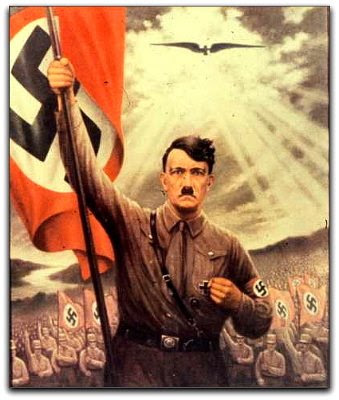
Hitler

Hitler: 1889-1936 Hubris


https://blogger.googleusercontent.com/img/b/R29vZ2xl/AVvXsEgG7L8hNjM1HhCm5h_D5gt1PMy6Mo_If44JjkE6uHpkGvfegC7KdIkSNg03oET32t-wus-W84zT7Z-0Gfx5wsVEoGtsoXBN6Nf8ZvKBh5lfm5sqf_2whBUaZbFYfU7DiZYwN-83m3atfgM/s400/screen-clip-hitler-w-paraclete2.jpg

Ian Kershaw's Hitler: 1889-1936 Hubris by all accounts is set to become the standard work on Hitler for the 21st century. That's certainly possible, but how would I know? The facts and figures he cites certainly seem extraordinarily complete, but I certainly don't have the background to question his opinions on which sources should and should not be trusted, which have or have not been discredited, and which have pieces missing. This volume chronicles Hitler's birth to his rise to power. I haven't even read the sequel, yet.

This volume at least is astonishing in that it makes so evident how easy it is for one to "know" about Hitler and his extermination of the Jews during World War II, while knowing nothing about German politics, previous wars, Hitler's rise to power — in essence knowing nothing substantial about Hitler at all in anything but name.

This is not to say that Kershaw claims in any way to reveal the "real" Hitler, the true, undiscovered individual that eluded even those close to him. Rather Kershaw documents a series of events, as accurately as possible, providing just as much emphasis on Hitler's environment as on Hitler himself. What comes out of this is a whole new story — no new core revelations or dramatic historical alterations, perhaps, but a brilliant display of how one person could discover in himself a gift of rhetoric in a particular political climate. In Hitler's messianic view, he and the German people found each other.

This mythos emanated no less from the people's reception than from the constant underhanded political manipulation by Hitler, and it is again astonishing how one man could in whatever environment control such a manipulation, while in many cases having so little control on grassroots circumstances.

Too much commentary here would certainly do injustice to this first volume of such a thorough work. The seemingly never-ending yet never boring work succeeds best at its constant pace of filling in the structure of that history. Here are a few salient items that I found particularly interesting.

  • The doctor of Hitler's mother, whose name was Eduard Bloch, was Jewish (12).
  • While in Vienna, Hitler was sustained in large part through sales of his paintings. "His closest partner... in his little art-production business, Josef Neumann, was also a Jew — and one with whom Hitler was, it seems on friendly terms" (55).
  • After World War I, inflation was rampant in Germany. "Where there had been 4.20 Marks to the dollar on the eve of the First World War, there were 17,972 Marks in January 1923, 4,620,455 Marks in August, 98,860,000 Marks in September, 25,260,280,000 in October, and a barely credible 4,200,000 million Marks by 15 November. By mid-September, a kilo of butter was costing 168 million Marks" (201).
  • The putsch of 1923 was stopped by a "furious gun-battle lasting almost half a minute...", bullets from the police killed "fourteen putschists", and four policemen were killed. "Had the bullet which killed Scheubner-Richter been a foot to the right, history would have taken a different course" by killing Hitler (211).
  • After the failed putsch, and after Hitler was released from Landsberg, "Hitler inquired in March 1925 how he could relinquish his Austrian citizenship" so he could not later be deported to Austria, as the Bavarian government had tried to do (238).
  • In May 1924, after Hitler had already been working on the first volume of Mein Kampf, he was calling the work, "Four and a Half Years of Struggle against Lies, Stupidity, and Cowardice" (241).
  • A Braille version of Mein Kampf was published in 1936, and "from that year, a copy of the people's edition of both volumes bound together was given to each happy couple on their wedding day" (242).
  • The 'idea' he stood for was not a matter of short-term objectives. It was a 'mission', a 'vision' of long-term future goals, and of his own part in the accomplishment of them. Certainly, these goals — national salvation through 'removal' of the Jews and acquisition of 'living-space' in the east — did not amount to short-term practical policy guidelines. But, incorporated into the notion of the 'heroic' leader, they did amount to a dynamic 'world-view'. This 'world-view' gave Hitler his unremitting drive. He spoke repeatedly of his 'mission'. He saw the hand of 'Providence' in his work. He regarded his fight against the Jew as 'the work of the Lord'. He saw his life's work as a crusade... He was no mere propogandist or 'unprincipled opportunist'. He was indeed both a masterly propogandist and and ideologue. There was no contradiction between the two (252).
  • Hitler spoke out against what he called "the 'bastardization' of culture, morals, and blood," claiming it was "undermining the value of the individual... 'The German people has its specific value and cannot be set on an equal level to 70 million negroes... Negro music is dominant, but if we put a Beethoven symphony alongside a shimmy, victory is clear...'" (305).
  • On 14 September 1930, the NSDAP advanced from 12 seats and 2.6% of the vote in the 1928 Reichstag election to 107 seats and 18.3%, "making it the second largest party in the Reichstag" (333).
  • Thomas Mann in his "German Address" (Deutsche Ansprache) in Berlin on 17 October, gave what Kershaw calls "a simplistic assessment of the NSDAP's breakthrough", calling the NSDAP "politics in the grotesque style with salvation-army attractions (Allüren), mass fits, showground-stall bell-ringing, hallelujah, and dervish-like repetition of monotonous slogans till everyone is foaming at the mouth" (336).
  • On 1 September, 1930, Hitler solved problems in the SA and SS by announcing that he himself was taking over their supreme leadership (347).
  • On 13 August 1932, Reich President Hindenburg rejected Hitler as Reich Chancellor, even though the NSDAP had won its victories at the polls (374).
  • In the fall of 1932, most people apparently thought there was at lesat some things in the NSDAP they agreed with. "The loathing and deep fear of Communism that ran through some four-fifths of society was one important common denominator. Faced with a stark choice between National Socialism and Communism — which was how Hitler was increasingly able to portray it after his takeover of power &mdsash; most middle-class and well-to-do Germans, and even a considerable leaven of the working class, preferred the Nazis. The Communists were revolutionaries, they would take away private property, impose a class dictatorship, and rule in the interests of Moscow. The National Socialists were vulgar and distasteful, but they stood for German interests, they would uphold German values, and they would not take away private property. Crudely put, this reflected a wide-spread tread of thought, not least in the middle class (409).
  • The rapidity of the transformation that swept over Germany between Hitler's takeover of power on 30 January 1933 and its crucial consolidation and extension at the beginning of August 1934, after Reich President Hindenburg's death and following close on the major crisis of the 'Röhm afffair', was astounding for contemporaries and is scarcely less astonishing in retrospect... Within a month, civil liberties — as protected under the Weimar Constitution — had been extinguished. Within two months, with most active political opponents either imprisoned or fleeing the country, the Reichtag surrendered its powers, giving Hitler control of the legislature. Within four months the once powerful trade unions were dissolved. In less than six months, all opposition parties had been suppressed or gone into voluntary liquidation, leaving the NSDAP as the only remaining party. In January 1934, the sovereignty of the Lander — already in reality smashed the previous March — was formally abolished. Then, in the summer, the growing thread from within Hitler's own movement was ruthlessly eliminated in the 'Night of the Long Knives' on 30 June 1934 (435).
  • Hitler had ideas of German society "in which old class privileges had disappeared, exploiting the benefits of modern technology and a higher standard of living. But he thought essentially in terms of race, not class, of conquest, not economic modernization. Everything was consistently predicated on war to establish dominion" (449).
  • The first concentration camp, housing those seized during large-scale arrests of Communists and Socialists, was set up in Dachau on 22 March 1933, about twelve miles from Munich, in a former powder-mill (464).
  • On 23 March 1933, "with 441 votes to the ninety-four votes of the Social Democrats, the Reichstag, as a democratic body, voted itself out of existence" (468).
  • On 5 July 1933, "the Zentrum, the last remaining political party outside the NSDAP, dissolved itself. Little over a week later, the 'Law against the New Construction of Parties' left the NSDAP as the only legal political party in Germany" (478).
  • Philosopher Martin Heidegger and constitutional lawyer Carl Schmitt supported Hitler's regime (481).
  • Concerning forced sterilization of those with hereditary illness, even applied to chronic alcoholism, Hitler felt that, "All measures were justified which served the upholding of nationhood (Volkstum)" (487).
  • 30 June 1934 became known as the "Night of the Long Knives" in which many of the main opponents of Hitler (and some whose identities were mistaken) were murdered (520).
  • Kershaw, referencing Willikens, explains how a person's chances of success in Hitler's regime depended on that person demonstrating how effectively he/she was "working towards the Führer" by doing what was assumed Hitler would want. Hitler did not to become involved in immediate disputes. "Hitler was, therefore, at one and the same time the absolutely indispensable fulcrum of the entire regime, and yet largely detached from any formal machinery of government. The result, inevitably, was a high level of governmental and administrative disorder" (523).
  • When Hitler informed ambassadors on 16 March 1935 of his expansion of the army and the introduction of general military service, American journalist William Shirer, who witnessed the event in Berlin, wrote, "Today's creation of a conscript army in open defiance of Versailles will greatly enhance his domestic position, for there are few Germans, regardless of how much they hate the Nazis, who will not support it wholeheartedly. The great majority will like the way he has thumbed his nose at Versailles, which they all resented" (551-552).

more deatils; wikipediya

lenin

Vladimir Ilyich Lenin
(1870-1924)


http://www.amath.washington.edu/%7Eslemons/imagesdir/lenin.jpg

Not long after the Bolsheviks had seized power in 1917, Vladimir Ilyich Lenin filled out a bureaucratic questionnaire. For occupation, he wrote "man of letters." So it was that a son of the Russian intelligentsia, a radical straight from the pages of Dostoyevsky's novel The Possessed, became the author of mass terror and the first concentration camps ever built on the European Continent.

Lenin was the initiator of the central drama--the tragedy--of our era, the rise of totalitarian states. A bookish man with a scholar's habits and a general's tactical instincts, Lenin introduced to the 20th century the practice of taking an all-embracing ideology and imposing it on an entire society rapidly and mercilessly; he created a regime that erased politics, erased historical memory, erased opposition. In his short career in power, from 1917 until his death in 1924, Lenin created a model not merely for his successor, Stalin, but for Mao, for Hitler, for Pol Pot.

And while in this way Lenin may be the central actor who begins the 20th century, he is the least knowable of characters. As a boy growing up in Simbirsk, Lenin distinguished himself in Latin and Greek. The signal event of his youth--the event that radicalized him--came in 1887, when his eldest brother Alexander, a student at the University of St. Petersburg, was hanged for conspiring to help assassinate Czar Alexander III. As a lawyer, Lenin became increasingly involved in radical politics, and after completing a three-year term of Siberian exile, he began his rise as the leading communist theorist, tactician and party organizer.

In his personal relations with colleagues, family and friends, Lenin was relatively open and generous. Unlike many tyrants, he did not crave a tyrant's riches. Even when we strip Lenin of the cult that was created all around him after his death, when we strip away the myths of his "superhuman kindness," he remains a peculiarly modest figure who wore a shabby waistcoat, worked 16-hour days and read extensively. (By contrast, Stalin did not know that the Netherlands and Holland were the same country, and no one in the Kremlin inner circle was brave enough to set him straight.)

Before he became the general of the revolution, Lenin was its pedant, the journalist-scholar who married Marxist theory to an incisive analysis of insurrectionist tactics. His theories of what society ought to be and how that ideal must be achieved were the products of thousands of hours spent reading.

"The incomprehensibility of Lenin is precisely this all-consuming intellectuality--the fact that from his calculations, from his neat pen, flowed seas of blood, whereas by nature this was not an evil person," writes Andrei Sinyavsky, one of the key dissidents of the 1960s. "On the contrary, Vladimir Ilyich was a rather kind person whose cruelty was stipulated by science and incontrovertible historical laws. As were his love of power and his political intolerance."

For all his learning, Lenin began the Bolshevik tradition of waging war on intellectual dissidents--of exiling, imprisoning and executing thinkers and artists who dared oppose the regime. He was a "man of letters" of a particular sort. In the years before and after the October 1917 coup, Lenin was the avatar of a group of radical intellectuals who sought a revolution that did not merely attempt to redress the economic balances under czarism. Instead, Lenin made a perverse reading of the Enlightenment view of man as modeling clay and sought to create a new model of human nature and behavior through social engineering of the most radical kind.

"Bolshevism was the most audacious attempt in history to subject the entire life of a country to a master plan," writes Richard Pipes at the end of his two-volume history of the revolution. "It sought to sweep aside as useless rubbish the wisdom that mankind had accumulated over millennia. In that sense, it was a unique effort to apply science to human affairs: and it was pursued with the zeal characteristic of the breed of intellectuals who regard resistance to their ideas as proof that they are sound."

It is, perhaps, impossible to calculate just how many tens of millions of murders "flowed" from Leninism. Certainly Stalin differed from Lenin in the length of his time as dictator--some 25 years to Lenin's six--and he also had the advantage of greater technology. As a result, Stalin's murderous statistics are superior to Lenin's. And yet Lenin contributed so very much.

In some scholarly circles in the West, Stalin was seen as an "aberration," a tyrant who perverted Lenin's intentions at the end of Lenin's life. But as more and more evidence of Lenin's cruelty emerged from the archives, that notion of the "good Lenin" and the "bad Stalin" became an academic joke. Very few of Stalin's policies were without roots in Leninism: it was Lenin who built the first camps; Lenin who set off artificial famine as a political weapon; Lenin who disbanded the last vestige of democratic government, the Constituent Assembly, and devised the Communist Party as the apex of a totalitarian structure; Lenin who first waged war on the intelligentsia and on religious believers, wiping out any traces of civil liberty and a free press.

Since the Soviet archives became public, we have been able to read the extent of Lenin's cruelty, the depths of its vehemence. Here he is in 1918, in a letter instructing Bolshevik leaders to attack peasant leaders who did not accept the revolution: "Comrades! ... Hang (hang without fail, so that people will see) no fewer than one hundred known kulaks, rich men, bloodsuckers ... Do it in such a way that ... for hundreds of versts around, the people will see, tremble, know, shout: 'They are strangling and will strangle to death the sucker kulaks' ... Yours, Lenin."

Among those artists and writers who survived the revolution and its aftermath, many wrote paeans to Lenin's intelligence that sound like nothing so much as religious songs of praise. The poet Mayakovsky would write, "Then over the world loomed/ Lenin of the enormous head." And later, the prose writer Yuri Olesha would say, "Now I live in an explained world. I understand the causes. I am filled with a feeling of enormous gratitude, expressible only in music, when I think of those who died to make the world explained."

By the Brezhnev era, Lenin's dream state had devolved into a corrupt and failing dictatorship. Only the Lenin cult persisted. The ubiquitous Lenin was a symbol of the repressive society itself. Joseph Brodsky, the great Russian poet of the late 20th century, began to hate Lenin at about the time he was in the first grade, "not so much because of his political philosophy or practice ... but because of the omnipresent images which plagued almost every textbook, every class wall, postage stamps, money, and what not, depicting the man at various ages and stages of his life ... This face in some ways haunts every Russian and suggests some sort of standard for human appearance because it is utterly lacking in character ...coming to ignore those pictures was my first lesson in switching off, my first attempt at estrangement."

When Mikhail Gorbachev instituted his policy of glasnost in the late 1980s, the Communist Party tried to practice a policy of regulated criticism. The goal was to "de-Stalinize" the Soviet Union, to resume Khrushchev's liberalization in the late 1950s. But eventually, glasnost led to the image of Lenin, not least with the publication of Vassily Grossman's Forever Flowing, a novel that dared compare Lenin's cruelty to Hitler's. While he was in office, Gorbachev always called himself a "confirmed Leninist"; it was only years later when he too--the last General Secretary of the Communist Party--admitted, "I can only say that cruelty was the main problem with Lenin."

After the collapse of the coup in August 1991, the people of Leningrad voted to call their city St. Petersburg once more. When Brodsky, who had been exiled from the city in 1964, was asked about the news, he smiled and said, "Better to have named it for a saint than a devil."

more deatils; wikipediya

dickens

Charles Dickens, 1812-1870

http://www.imsa.edu/learning/acprograms/english/images/CharlesDickens.jpg

Novelist, born at Landport, near Portsmouth, where his father was a clerk in the Navy Pay–Office. The hardships and mortifications of his early life, his want of regular schooling, and his miserable time in the blacking factory, which form the basis of the early chapters of David Copperfield, are largely accounted for by the fact that his father was to a considerable extent the prototype of the immortal Mr. Micawber; but partly by his being a delicate and sensitive child, unusually susceptible to suffering both in body and mind. He had, however, much time for reading, and had access to the older novelists, Fielding, Smollett, and others. A kindly relation also took him frequently to the theatre, where he acquired his life-long interest in, and love of, the stage.

After a few years’ residence in Chatham, the family removed to London, and soon thereafter his father became an inmate of the Marshalsea, in which by-and-by the whole family joined him, a passage in his life which furnishes the material for parts of Little Dorrit. This period of family obscuration happily lasted but a short time: the elder Dickens managed to satisfy his creditors, and soon after retired from his official duties on a pension. About the same time Dickens had two years of continuous schooling, and shortly afterwards he entered a law office. His leisure he devoted to reading and learning shorthand, in which he became very expert. He then acted as parliamentary reporter, first for The True Sun, and from 1835 for the Morning Chronicle. Meanwhile he had been contributing to the Monthly Magazine and the Evening Chronicle the papers which, in 1836, appeared in a collected form as Sketches by Boz; and he had also produced one or two comic burlettas.

In the same year he married Miss Catherine Hogarth; and in the following year occurred the opportunity of his life. He was asked by Chapman and Hall to write the letterpress for a series of sporting plates to be done by Robert Seymour who, however, died shortly after, and was succeeded by Hablot Browne (Phiz), who became the illustrator of most of Dickens’s novels. In the hands of Dickens the original plan was entirely altered, and became the Pickwick Papers which, appearing in monthly parts during 1837–39, took the country by storm. Simultaneously Oliver Twist was coming out in Bentley’s Miscellany. Thenceforward Dickens’s literary career was a continued success, and the almost yearly publication of his works constituted the main events of his life. Nicholas Nickleby appeared in serial form 1838–39. Next year he projected Master Humphrey’s Clock, intended to be a series of miscellaneous stories and sketches. It was, however, soon abandoned, The Old Curiosity Shop and Barnaby Rudge taking its place. The latter, dealing with the Gordon Riots, is, with the partial exception of the Tale of Two Cities, the author’s only excursion into the historical novel.

In 1841 Dickens went to America, and was received with great enthusiasm, which, however, the publication of American Notes considerably damped, and the appearance of Martin Chuzzlewit in 1843, with its caustic criticisms of certain features of American life, converted into extreme, though temporary, unpopularity. The first of the Christmas books — the Christmas Carol — appeared in 1843, and in the following year Dickens went to Italy, where at Genoa he wrote The Chimes, followed by The Cricket on the Hearth, The Battle of Life, and The Haunted Man.

In January, 1846, he was appointed first ed. of The Daily News, but resigned in a few weeks. The same year he went to Switzerland, and while there wrote Dombey and Son, which was published in 1848, and was immediately followed by his masterpiece, David Copperfield (1849–50). Shortly before this he had become manager of a theatrical company, which performed in the provinces, and he had in 1849 started his magazine, Household Words. Bleak House appeared in 1852–53, Hard Times in 1854, and Little Dorrit 1856–57. In 1856 he bought Gadshill Place, which, in 1860, became his permanent home.

In 1858 he began his public readings from his works, which, while eminently successful from a financial point of view, from the nervous strain which they entailed, gradually broke down his constitution, and hastened his death. In the same year he separated from his wife, and consequent upon the controversy which arose thereupon he brought Household Words to an end, and started All the Year Round, in which appeared A Tale of Two Cities (1859), and Great Expectations (1860–61). Our Mutual Friend came out in numbers (1864–65). Dickens was now in the full tide of his readings, and decided to give a course of them in America. Thither accordingly he went in the end of 1867, returning in the following May. He had a magnificent reception, and his profits amounted to £20,000; but the effect on his health was such that he was obliged, on medical advice, finally to abandon all appearances of the kind. In 1869 he began his last work, The Mystery of Edwin Drood, which was interrupted by his death from an apoplectic seizure on June 8, 1870.

One of Dickens’s most marked characteristics is the extraordinary wealth of his invention as exhibited in the number and variety of the characters introduced into his novels. Another, especially, of course, in his entire works, is his boundless flow of animal spirits. Others are his marvellous keenness of observation and his descriptive power. And the English race may well, with Thackeray, be “grateful for the innocent laughter, and the sweet and unsullied pages which the author of David Copperfield gives to [its] children.” On the other hand, his faults are obvious, a tendency to caricature, a mannerism that often tires, and almost disgusts, fun often forced, and pathos not seldom degenerating into mawkishness. But at his best how rich and genial is the humour, how tender often the pathos. And when all deductions are made, he had the laughter and tears of the English-speaking world at command for a full generation while he lived, and that his spell still works is proved by a continuous succession of new editions.

more deatils; wikipediya

karl marx


karl marx


http://upload.wikimedia.org/wikipedia/commons/f/fc/Karl_Marx.jpgThe worker becomes all the poorer the more wealth he produces, the more his production increases in power and range. The worker becomes an ever cheaper commodity the more commodities he creates. With the increasing value of the world of things proceeds in direct proportion to the devaluation of the world of men. Labour produces not only commodities; it produces itself and the worker as a commodity -- and does so in the proportion in which it produces commodities generally.

Marx, Economic and Philosophic Manuscripts (1844)

The philosopher, social scientist, historian and revolutionary, Karl Marx, is without a doubt the most influential socialist thinker to emerge in the 19th century. Although he was largely ignored by scholars in his own lifetime, his social, economic and political ideas gained rapid acceptance in the socialist movement after his death in 1883. Until quite recently almost half the population of the world lived under regimes that claim to be Marxist. This very success, however, has meant that the original ideas of Marx have often been modified and his meanings adapted to a great variety of political circumstances. In addition, the fact that Marx delayed publication of many of his writings meant that is been only recently that scholars had the opportunity to appreciate Marx's intellectual stature.

Jenny von Westphalen, 1850sKarl Heinrich Marx was born into a comfortable middle-class home in Trier on the river Moselle in Germany on May 5, 1818. He came from a long line of rabbis on both sides of his family and his father, a man who knew Voltaire and Lessing by heart, had agreed to baptism as a Protestant so that he would not lose his job as one of the most respected lawyers in Trier. At the age of seventeen, Marx enrolled in the Faculty of Law at the University of Bonn. At Bonn he became engaged to Jenny von Westphalen, the daughter of Baron von Westphalen , a prominent member of Trier society, and man responsible for interesting Marx in Romantic literature and Saint-Simonian politics. The following year Marx's father sent him to the more serious University of Berlin where he remained four years, at which time he abandoned his romanticism for the Hegelianism which ruled in Berlin at the time.

Marx became a member of the Young Hegelian movement. This group, which included the theologians Bruno Bauer and David Friedrich Strauss, produced a radical critique of Christianity and, by implication, the liberal opposition to the Prussian autocracy. Finding a university career closed by the Prussian government, Marx moved into journalism and, in October 1842, became editor, in Cologne, of the influential Rheinische Zeitung, a liberal newspaper backed by industrialists. Marx's articles, particularly those on economic questions, forced the Prussian government to close the paper. Marx then emigrated to France.

Friedrich Engels, 1820-1895Arriving in Paris at the end of 1843, Marx rapidly made contact with organized groups of émigré German workers and with various sects of French socialists. He also edited the short-lived Deutsch-Französische Jahrbücher which was intended to bridge French socialism and the German radical Hegelians. During his first few months in Paris, Marx became a communist and set down his views in a series of writings known as the Economic and Philosophical Manuscripts (1844), which remained unpublished until the 1930s. In the Manuscripts, Marx outlined a humanist conception of communism, influenced by the philosophy of Ludwig Feuerbach and based on a contrast between the alienated nature of labor under capitalism and a communist society in which human beings freely developed their nature in cooperative production. It was also in Paris that Marx developed his lifelong partnership with Friedrich Engels (1820-1895).

30 Rue Vanneau, ParisMarx was expelled from Paris at the end of 1844 and with Engels, moved to Brussels where he remained for the next three years, visiting England where Engels' family had cotton spinning interests in Manchester. While in Brussels Marx devoted himself to an intensive study of history and elaborated what came to be known as the materialist conception of history. This he developed in a manuscript (published posthumously as The German Ideology), of which the basic thesis was that "the nature of individuals depends on the material conditions determining their production." Marx traced the history of the various modes of production and predicted the collapse of the present one -- industrial capitalism -- and its replacement by communism.

At the same time Marx was composing The German Ideology, he also wrote a polemic (The Poverty of Philosophy) against the idealistic socialism of P. J. Proudhon (1809-1865). He also joined the Communist League. This was an organization of German émigré workers with its center in London of which Marx and Engels became the major theoreticians. At a conference of the League in London at the end of 1847 Marx and Engels were commissioned to write a succinct declaration of their position. Scarcely was The Communist Manifesto published than the 1848 wave of revolutions broke out in Europe.

Early in 1848 Marx moved back to Paris when a revolution first broke out and onto Germany where he founded, again in Cologne, the Neue Rheinische Zeitung. The paper supported a radical democratic line against the Prussian autocracy and Marx devoted his main energies to its editorship since the Communist League had been virtually disbanded. Marx's paper was suppressed and he sought refuge in London in May 1849 to begin the "long, sleepless night of exile" that was to last for the rest of his life.

Settling in London, Marx was optimistic about the imminence of a new revolutionary outbreak in Europe. He rejoined the Communist League and wrote two lengthy pamphlets on the 1848 revolution in France and its aftermath, The Class Struggles in France and The 18th Brumaire of Louis Bonaparte. He was soon convinced that "a new revolution is possible only in consequence of a new crisis" and then devoted himself to the study of political economy in order to determine the causes and conditions of this crisis.

28 Dean Street, LondonDuring the first half of the 1850s the Marx family lived in poverty in a three room flat in the Soho quarter of London. Marx and Jenny already had four children and two more were to follow. Of these only three survived. Marx's major source of income at this time was Engels who was trying a steadily increasing income from the family business in Manchester. This was supplemented by weekly articles written as a foreign correspondent for the New York Daily Tribune.

Marx's major work on political economy made slow progress. By 1857 he had produced a gigantic 800 page manuscript on capital, landed property, wage labor, the state, foreign trade and the world market. The Grundrisse (or Outlines) was not published until 1941. In the early 1860s he broke off his work to compose three large volumes, Theories of Surplus Value, which discussed the theoreticians of political economy, particularly Adam Smith and David Ricardo. It was not until 1867 that Marx was able to publish the first results of his work in volume 1 of Capital, a work which analyzed the capitalist process of production. In Capital, Marx elaborated his version of the labor theory value and his conception of surplus value and exploitation which would ultimately lead to a falling rate of profit in the collapse of industrial capitalism. Volumes II and III were finished during the 1860s but Marx worked on the manuscripts for the rest of his life and they were published posthumously by Engels.

Jenny, Laura, Eleanor, Engels and Marx (1864)One reason why Marx was so slow to publish Capital was that he was devoting his time and energy to the First International, to whose General Council he was elected at its inception in 1864. He was particularly active in preparing for the annual Congresses of the International and leading the struggle against the anarchist wing led by Mikhail Bakunin (1814-1876). Although Marx won this contest, the transfer of the seat of the General Council from London to New York in 1872, which Marx supported, led to the decline of the International. The most important political event during the existence of the International was the Paris Commune of 1871 when the citizens of Paris rebelled against their government and held the city for two months. On the bloody suppression of this rebellion, Marx wrote one of his most famous pamphlets, The Civil War in France, an enthusiastic defense of the Commune.

During the last decade of his life, Marx's health declined and he was incapable of sustained effort that had so characterized his previous work. He did manage to comment substantially on contemporary politics, particularly in Germany and Russia. In Germany, he opposed in his Critique of the Gotha Programme, the tendency of his followers Wilhelm Liebknecht (1826-1900) and August Bebel (1840-1913) to compromise with state socialism of Lasalle in the interests of a united socialist party. In his correspondence with Vera Zasulich Marx contemplated the possibility of Russia's bypassing the capitalist stage of development and building communism on the basis of the common ownership of land characteristic of the village mir.

Marx's gravesite, Highgate Cemetary, LondonMarx's health did not improve. He traveled to European spas and even to Algeria in search of recuperation. The deaths of his eldest daughter and his wife clouded the last years of his life. Marx died March 14, 1883 and was buried at Highgate Cemetery in North London. His collaborator and close friend Friedrich Engels delivered the following eulogy three days later:

On the 14th of March, at a quarter to three in the afternoon, the greatest living thinker ceased to think. He had been left alone for scarcely two minutes, and when we came back we found him in his armchair, peacefully gone to sleep -- but for ever.

An immeasurable loss has been sustained both by the militant proletariat of Europe and America, and by historical science, in the death of this man. The gap that has been left by the departure of this mighty spirit will soon enough make itself felt.

Just as Darwin discovered the law of development or organic nature, so Marx discovered the law of development of human history: the simple fact, hitherto concealed by an overgrowth of ideology, that mankind must first of all eat, drink, have shelter and clothing, before it can pursue politics, science, art, religion, etc.; that therefore the production of the immediate material means, and consequently the degree of economic development attained by a given people or during a given epoch, form the foundation upon which the state institutions, the legal conceptions, art, and even the ideas on religion, of the people concerned have been evolved, and in the light of which they must, therefore, be explained, instead of vice versa, as had hitherto been the case.

But that is not all. Marx also discovered the special law of motion governing the present-day capitalist mode of production, and the bourgeois society that this mode of production has created. The discovery of surplus value suddenly threw light on the problem, in trying to solve which all previous investigations, of both bourgeois economists and socialist critics, had been groping in the dark.

Two such discoveries would be enough for one lifetime. Happy the man to whom it is granted to make even one such discovery. But in every single field which Marx investigated -- and he investigated very many fields, none of them superficially -- in every field, even in that of mathematics, he made independent discoveries.

Such was the man of science. But this was not even half the man. Science was for Marx a historically dynamic, revolutionary force. However great the joy with which he welcomed a new discovery in some theoretical science whose practical application perhaps it was as yet quite impossible to envisage, he experienced quite another kind of joy when the discovery involved immediate revolutionary changes in industry, and in historical development in general. For example, he followed closely the development of the discoveries made in the field of electricity and recently those of Marcel Deprez.

For Marx was before all else a revolutionist. His real mission in life was to contribute, in one way or another, to the overthrow of capitalist society and of the state institutions which it had brought into being, to contribute to the liberation of the modern proletariat, which he was the first to make conscious of its own position and its needs, conscious of the conditions of its emancipation. Fighting was his element. And he fought with a passion, a tenacity and a success such as few could rival. His work on the first
Rheinische Zeitung (1842), the Paris Vorwarts (1844), the Deutsche Brusseler Zeitung (1847), the Neue Rheinische Zeitung (1848-49), the New York Tribune (1852-61), and, in addition to these, a host of militant pamphlets, work in organisations in Paris, Brussels and London, and finally, crowning all, the formation of the great International Working Men's Association -- this was indeed an achievement of which its founder might well have been proud even if he had done nothing else.

And, consequently, Marx was the best hated and most calumniated man of his time. Governments, both absolutist and republican, deported him from their territories. Bourgeois, whether conservative or ultra-democratic, vied with one another in heaping slanders upon him. All this he brushed aside as though it were a cobweb, ignoring it, answering only when extreme necessity compelled him. And he died beloved, revered and mourned by millions of revolutionary fellow workers -- from the mines of Siberia to California, in all parts of Europe and America -- and I make bold to say that, though he may have had many opponents, he had hardly one personal enemy.

His name will endure through the ages, and so also will his work.

Marx's contribution to our understanding of society has been enormous. His thought is not the comprehensive system evolved by some of his followers under the name of dialectical materialism. The very dialectical nature of his approach meant that it was usually tentative and open-ended. There was also the tension between Marx the political activist and Marx the student of political economy. Many of his expectations about the future course of the revolutionary movement have, so far, failed to materialize. However, his stress on the economic factor in society and his analysis of the class structure in class conflict have had an enormous influence on history, sociology, and study of human culture.

more deatils; wikipediya